Description
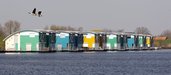
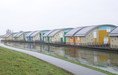
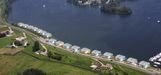
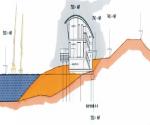
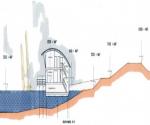
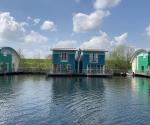
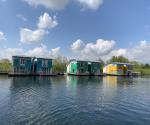
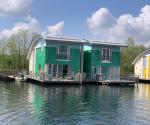
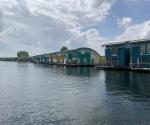
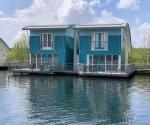
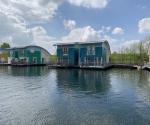
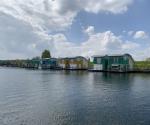
In a recreation area located outside the dikes near Maasbommel in Gelderland Province, 32 amphibious and 14 floating homes have been realised. The amphibious homes are fastened to flexible mooring posts and rest on concrete foundations. If the river level rises, they can move upwards and float. The fastenings to the mooring posts limit the motion caused by the water. The floating homes are lowered when the water level drops and come to rest on concrete foundations.
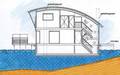
The floating and semi-floating homes are similar in construction: a concrete barge with a relatively light timber-frame construction on top. The concrete barges weigh 72 tonnes each, while the timber-frame constructions weigh around 22 tonnes. The low centre of gravity gives added stability. The concrete barges are made from ordinary concrete with an aggregate to render them waterproof. The joints are reinforced with an additional water-resistant sealing strip. The barges are approximately 2 metres high, and as such can only be used as basements or, if part of the home is designed with a split level, as bedrooms.
Projections indicate that the water level will rise by more than 70 cm once every five years, causing the homes to rise accordingly. The homes can handle fluctuations of up to 5.5 metres. [Pötz et al., 2009]
Tauw, Deltacync and Deltares conducted a nation-wide survey on the effects of floating urbanization on water quality and ecology. Over the past few months the survey was conducted, using a so-called underwater drone. The drone measured the water quality while filming the whole procedure. Underneath the floating gardens in Amsterdam even some rare freshwater sponges were found.
more info on:
http://repository.tudelft.nl/assets/u...
http://repository.tudelft.nl/view/ir/...
or webseminar:http://skbodem.nl/actueel/agenda/160
Dutch:
Drijvende woningen Maasbommel
Winnaar vakprijs Water Wonen & Ruimte Award
**De overstromingen in 1993 en 1995 leidden tot het grootschalige programma Ruimte voor de Rivier. In het kader van Ruimte voor de Rivier is de mogelijkheid om drijvende woningen te ontwikkelen onderzocht. In Maasbommel aan de recreatieplas De Gouden Ham zijn de eerste amfibische woningen van Nederland te vinden. In totaal kijken 46 woningen, twee aan twee, uit over het water. **
Permanent drijvende woningen en amfibische woningen
Er zijn twee type woningen in dit project: permanent drijvende woningen die door middel van een betonnen drijflichaam op het water liggen en amfibische woningen die alleen gaan drijven wanneer gemiddeld eens in de twintig jaar het waterniveau extreem stijgt. Deze woningen rusten met een betonnen drijflichaam op een fundament van betonpalen en worden met hoog water verticaal geleid met forse stalen palen. De aansluitingen voor gas, water, riolering en electra zijn flexibel en blijven functioneren bij hoog water. In februari 2011 zijn de amfibische woningen voor het eerst bij hoog water beproefd.
Factor Architecten en Dura Vermeer hebben de vakprijs Water Wonen & Ruimte Award gewonnen met dit project. Deze prijs werd uitgereikt tijdens het Nationaal Water Wonen & Ruimte Congres op 8 september 2010 in Almere. De jury wees in de categorie ‘gerealiseerd’ de Gouden Kust als winnaar aan, mede vanwege de grote iconische waarde van het project.
Monitoring and results?
Floating urbanization is a promising solution to reduce the vulnerability of cities against climate change, population growth or land scarcity. Although this type of construction introduces changes to aquatic systems, there is a lack of research studies addressing potential impacts. Water quality data collected under/near floating structures were compared with the corresponding parameters measured at the same depth at open water locations by (i) performing scans with underwater drones equipped with in situ sensors and video cameras and (ii) fixing two sets of continuous measuring in situ sensors for a period of several days/months at both positions. A total of 18 locations with different types of floating structures were considered in this study. Results show small differences in the measured parameters, such as lower dissolved oxygen concentrations or higher temperature measured underneath the floating structures. The magnitudes of these differences seem to be linked with the characteristics and type of water system. Given the wide variety and types of water bodies considered in this study, results suggest that water quality is not critically affected by the presence of the floating houses. Underwater images of biofouling and filter feeders illustrate the lively ecosystems that can emerge shortly after the construction of floating buildings.
Samenvatting (Dutch description)
Amfibische woningen bij Maasbommel - ebben mee met hoog en water water in de Maas
Help us provide more detailed information about this project by
contributing!